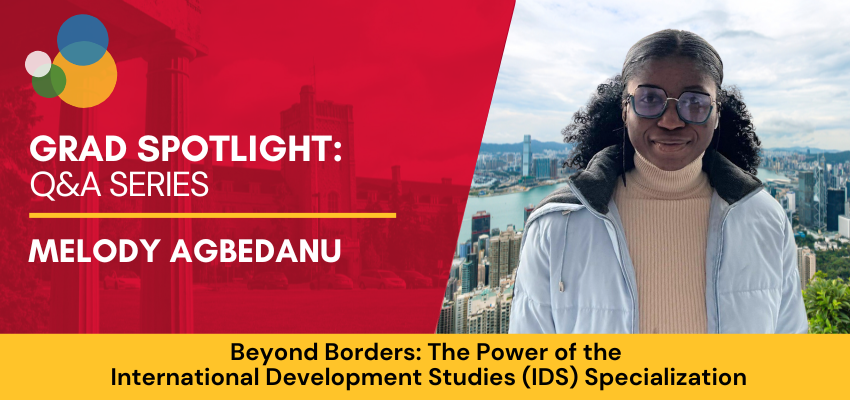
Melody Agbedanu Grad Spotlight: Beyond Borders - The Power of the International Development Studies (IDS) Specialization
What graduate program are you in, and what is the focus of your research?
I am a master’s student in Food, Agriculture, and Resource Economics (FARE), with an International Development Studies (IDS) Specialization. My research focuses on how food price shocks and uncertainties affect women and vulnerable households in sub-Saharan Africa. I’m especially interested in outcomes like child marriage, gendered migration patterns, and fertility. My goal is to understand how economic instability shapes the lives of women in low-income countries and to produce research that can guide policies that protect them.
What inspired you to add the International Development Studies (IDS) Collaborative Specialization to your graduate program?
I added the IDS specialization because I wanted my economic training to be grounded in real-world development issues. Coming from Ghana, I have seen how policy, inequality, and global shocks shape people’s daily lives. IDS gave me the chance to study these issues in an interdisciplinary way and connect my academic work to the lived experiences of communities like the one I grew up in. It felt like the right path to deepen my understanding and strengthen my research.
In what ways has participating in the IDS Specialization enriched your academic experience or influenced your research approach?
The IDS specialization has helped me look at problems beyond numbers and models. It pushed me to understand how gender, power, and social structures shape economic outcomes. Courses and discussions in IDS made my research more grounded in people’s lived realities, especially women in vulnerable communities. It also taught me to think more critically and collaborate across disciplines. IDS strengthened both my confidence and my ability to approach research with empathy and context.
What aspect of the specialization has made the strongest impression on you, and what important or surprising lesson resonated with you?
The strongest impression came from how open and honest the discussions in IDS are. It surprised me how much space there is to talk about injustice, inequality, and the human side of development. One lesson that stayed with me is that development is not just about fixing problems it’s about listening deeply, respecting lived experience, and understanding that change must include the voices of those most affected. That perspective continues to guide my work.
Reflecting on your journey so far, what accomplishment within your studies and career are you most proud of, and why?
I am most proud of graduating with First Class Honours in my undergraduate studies, an accomplishment that was especially meaningful because I was the only woman in my department to earn this distinction. Another moment that encouraged me was receiving the Lila Engberg Scholarship in International Development from the International Development Studies Department when I was admitted to my master’s degree. Being selected for this award affirmed my potential and showed me that my academic interests and commitment to development were recognized. These achievements continue to motivate me to work hard and contribute meaningfully through my studies.
As you look beyond graduate school, what career paths or aspirations are you most excited to pursue?
I am excited to work in areas that combine international development, policy analysis, gender equality and equity. My goal is to contribute to policies that protect vulnerable communities, especially women, from economic and social shocks. Whether through international organizations, research institutions, or development programs, I want to use my training to help create fairer and more resilient systems. Long term, I hope to influence policies that make a real difference in people’s lives.