The Looking Glass – From Colombia to Canada: Weaving Community, Research, and International Development
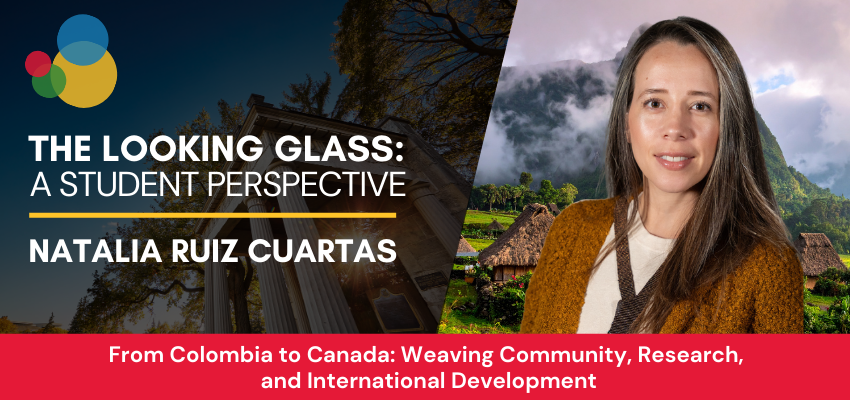
Natalia Ruiz Cuartas is a PhD candidate in Sociology and Development Studies. Her doctoral research explores the intersection of gender and agroecology in Cuba. She is an international student from Colombia and is working on the Gender Equity in Agricultural Science research project. Through the International Development Studies (IDS) Specialization, Natalia has been able to integrate theory and practice while expanding her understanding of development as a process shaped by diverse cosmologies, power structures, and lived realities. The program has strengthened her commitment to valuing traditional knowledge and critically examining political, social, economic, and environmental contexts across different territories—an approach that is central to her identity as a community-based scholar from Colombia.
From Colombia to Canada: Weaving Community, Research, and International Development
By Natalia Ruiz Cuartas, Sociology and Development Studies, PhD Candidate
Navigating Academia as a Latina Immigrant in Canada

Photo credit: Carlos Cardona
For over 12 years, I have worked in academia, the public sector, and as part of community-based initiatives with diverse populations, including survivors of the armed conflict in Colombia, individuals with disabilities, trans women, women's social movements, immigrants, women with refugee experiences, and rural and peasant communities. One of the most profound lessons I have received from these experiences has been embracing the strength of collective action and the power of building community and strong networks.
With these experiences under my belt, I came to Canada with my husband in 2019. Three years later, the opportunity to pursue my doctorate emerged through a chain of three women: Paola Gomez, Director of the community arts organization MUSE Arts, Heather White, staff at the University of Guelph, and Dr. Erin Nelson, Associate Professor at the University of Guelph and my PhD supervisor. Through an intricate web of connections—Paola being a mutual friend of mine and Heather’s, Heather being a mutual friend of Paola and Erin’s—I learnt about the Doctorate program and found myself applying to the University of Guelph with their support. This highlighted the importance of cultivating and maintaining networks, as such connections often open doors to opportunities that might otherwise remain out of reach.
My journey as a PhD student and emerging scholar has been profoundly shaped by my experience as a Latina immigrant woman. In 2022, I decided to take on the challenge of navigating a new system and undertaking formal studies in another language for the first time. Today, I feel a deep responsibility to recognize that this opportunity is a privilege, especially considering that, according to Statistics Canada, only 70 of the 5,350 PhD graduates in 2022 were Latin American.
Bridging Disciplines and Perspectives: The Impact of International Development Studies

Photo credit: Jean Carlos Lopez
At the University of Guelph, my academic program has allowed me to solidify some convictions, question others, and find common ground. Through my PhD program—along with my supervisor, doctoral committee, research, knowledge, networks and experiences—I have been able to interweave community work with academia, gender studies with agroecology, sociology with development, qualitative research with quantitative research methods. I have bridged languages, connecting English with Spanish; across communities, connecting peasant women and farmers with women scientists; across disciplines, uniting politics and research; and across contexts, bringing together the Global South with the Global North, as well as rural and urban spaces.
The International Development Studies (IDS) Specialization has enabled me to integrate theory and practice while deepening my understanding of what development entails. This broader perspective embraces diverse cosmologies, structures, and possibilities, while valuing traditional knowledge and considering the political, social, economic, and environmental contexts of different territories. As a decolonial, feminist, and community scholar from Colombia, this approach is fundamental to me.

Being part of the Sociology and International Development program at the University of Guelph, along with the international research project I am currently involved in, has allowed me to analyze, question, and challenge power structures and hierarchies of knowledge between the Global North and the South. Through this work, I have also contributed to building and strengthening connections between Canada and Latin America and the Caribbean.
For instance, in October 2025, through the IDRC-sponsored project titled Gender Equity in Agricultural Science, Dr. Erin Nelson and I hosted a knowledge exchange event in Colombia with 25 women farmers and agricultural scientists from Canada and six Latin American and Caribbean countries, many of whom were participants in my doctoral thesis. This event was particularly meaningful to me, serving as a bridge between the region where I was born and the place where I now live. It was transformative to find many connections and similarities, to collaborate creatively, and to share challenges and insights—moments in which national borders and differences faded, giving rise to collective knowledge-building.

Photo credit: Carlos Cardona
Additionally, through the project and with the support of my supervisor and research partners, and filmmaker Carlos Cardona, we produced the documentary Cubao is Theirs during my fieldwork in Cuba. The film tells the life stories of four peasant women who transformed their farms into sustainable food production systems, making a significant impact on their families, communities, and lives. The documentary will be released next year and not only represents the transnational work we have been doing, but also provides me with an opportunity to explore strategies for knowledge mobilization that make science more accessible to society as a whole.
Leadership, Transformation, and a Sense of Belonging
In this way, my career, as well as my professional, academic, and personal plans, have been enriched by the knowledge, skills, and practices gained through my studies at the University of Guelph, particularly by enhancing my graduate degree with a specialization in International Development Studies. Through transnational work, international policy analysis, and witnessing the transformative power of these intersections at both local and global levels, I have developed my leadership skills and, above all, cultivated a deep sense of belonging in Canada, a place I now call home and am committed to helping build.